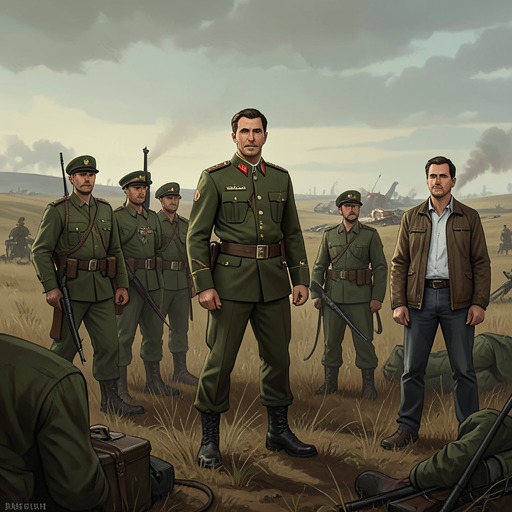
Bardamu suffers a panic attack at Duval’s and is taken away
Journey to the End of the NightBardamu suffers a panic attack at Duval’s and is taken away after his fear of wartime death overwhelms his ability to distinguish an imagined threat from the people around him. The episode makes the war’s violence seem to have followed him into civilian space: a restaurant and hotel lobby become, in his perception, places where everyone is about to be shot. His warnings prompt his removal by the Military Police and lead to a period of medical observation, where the authorities must decide whether his terror is illness, disloyalty, or both.
From the shooting gallery to Duval’s
Earlier that day, Bardamu had been unsettled by a shooting-gallery scene. Its painted wedding, town hall, and marching regiment recalled the targets at which people had fired, and he suddenly understood himself as another target. He told Lola that they were shooting at him, but she answered that he was talking nonsense and urged him to leave before they caught cold. As they descended the Avenue Royale toward Saint-Cloud, she held his hand; he was so absorbed by the image of the tin wedding that he forgot to kiss her. He later identified this moment as the beginning of the agitation in his mind.
Lola tried to comfort him by suggesting dinner at Duval’s, where the crowd might cheer him, or a meal in her room. They chose the restaurant. Almost as soon as they sat down, however, Bardamu saw the rows of diners not as people at supper but as people waiting for bullets to come from every direction. The ordinary arrangement of a busy restaurant had become, to him, the staging of a mass shooting.
The panic becomes public
Bardamu called on the diners to get out, warning that they were going to be shot and killed. His fear did not stop at the restaurant. He was hurried back to Lola’s hotel, the Hôtel Paritz, where he saw the same danger in the people in the hallways, the clerks at the desk, the doorman, and the officers and generals moving through the building. In his perception, uniforms and rank offered no protection: everyone was exposed, and nobody would escape.
In the hotel lobby, Bardamu shouted again that the people were about to be shot and urged them to flee. The concierge led him to the bar and gave him something to drink; after he had drunk quite a lot, the Military Police arrived and took him away in handcuffs. Lola kissed him and helped them remove him. The scene turns private distress into a public disturbance, while Lola’s practical assistance marks her continued presence even as Bardamu’s fear makes ordinary reassurance ineffective.
A soldier under observation
At the hospital, Bardamu was said to have fallen ill and become delirious, driven mad by fear. His account does not settle whether this diagnosis captures the experience: he acknowledges that the doctors may have been right, but continues to regard escape from the world as preferable whether a person is considered sane or frightened. His condition is thus presented both as a medical crisis and as an intelligible response to the prospect of being killed.
The authorities did not immediately settle on a diagnosis. Some people treated him as an anarchist whose removal or execution would be convenient during wartime; others considered him sincerely insane and wanted him confined until the war ended, or at least for several months. Bardamu observes that people who claim to be sane can decide what counts as madness when they have the nerve and the majority on their side. The episode therefore places his terror inside a conflict over who has the power to define acceptable conduct during war.
Bardamu was kept under observation in a secondary school at Issy-les-Moulineaux, adapted to receive soldiers whose patriotism was judged impaired or dangerously sick. The wounded men there were watched by silent male nurses, and the institution sought to make them confess, by cajolery or force. Lola and Bardamu’s mother were permitted to visit him from time to time. After a variable period, men under observation could be sent to an asylum, back to the front, or, not infrequently, to a firing squad. His outburst at Duval’s thus leads into a system in which medical supervision and military discipline converge, and where a soldier’s fear may determine whether he is confined, returned to combat, or killed.
Fear, death, and military law
The panic is rooted in Bardamu’s earlier confrontation with the prospect of death and punishment. Recalling a ceremony in which a colonel had urged the regiment forward, he contrasts the colonel’s lack of imagination with his own awareness of what dying might mean. He wants his death to come much later, rather than immediately in the mud of Flanders, but sees no safe choice between advancing and turning away. If he were caught roaming, he imagines a hurried court-martial in an empty classroom, followed by a firing squad. The fear of battlefield death is therefore bound to the fear that the army will punish any attempt to avoid it.
That imagined military trial gives the later removal by the Military Police a wider significance. The authorities who take Bardamu away do not merely interrupt a scene in a restaurant; they carry him into a system where his state of mind will be assessed against wartime expectations. His warnings are treated as evidence of disorder, while the institution’s options include sending him back to the front. The scene exposes the narrowness of the distinction between illness and disobedience when the army requires soldiers to accept danger.
The same association between law and terror recurs later, when Bardamu fears being called to account by the Company in Fort-Gono. He imagines special judges and terrible laws as a passage that drags a poor man toward death, and calls the law a vast amusement park of suffering. When he warns Robinson that the law is dangerous, he again presents legal process as a threat intensified by a vulnerable person’s condition. These later reflections do not alter the outcome of the Duval’s episode, but they echo its governing fear: institutions that claim to classify and judge can make a frightened person’s prospects more perilous rather than more secure.
The episode’s narrative function
The movement from a painted shooting-gallery target to the imagined firing squad at Duval’s gives the panic its structure. The earlier image of the regiment being shot at has already made Bardamu feel personally exposed; the crowded restaurant then becomes the place where that fear spills into action. What begins as an inward recognition becomes a warning to strangers, a disturbance in a hotel, and finally an enforced transfer into medical and military supervision.
The episode also sharpens the contrast between Bardamu’s fear and public claims to sanity and patriotism. He does not present courage as an uncomplicated virtue: for him, the danger is real, and the demand to behave normally is made by people who continue the war. Yet the institution can answer his refusal or inability to conform by classifying him, watching him, and deciding where he will be sent. His panic therefore gives individual form to the book’s account of war as a system that administers fear while demanding its suppression.